
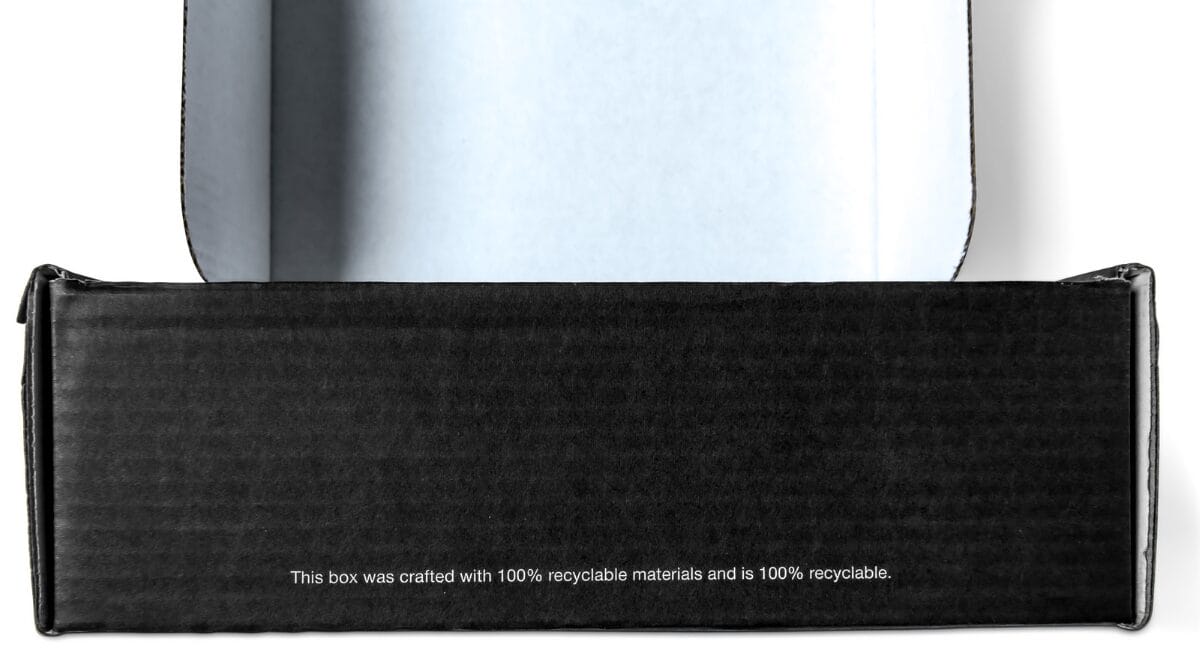
Did you know that certain design choices can make cardboard easier or harder to recycle? Some even make it impossible, which means your packaging will be headed straight for landfill.
We know for many small business owners, this is an honest mistake. There’s a lot to navigate when it comes to sustainability and you’re trying your best. The more you know; the better you can make the switch.
While we aren’t experts in sustainability, we are experts in cardboard packaging. We wanted to share a few design tips to help make sure your boxes are fully recyclable at the end of their life.
Most customers prefer recyclable packaging
Before we talk about how to make your packaging recyclable, we wanted to explore why it’s such an important choice.
The Retail Sustainability Spotlight is an annual survey from the ACRS at Monash University. According to their 2025 report, 51% of customers consider sustainability when shopping – which is a 5% increase since 2024.

But, what counts as a sustainable purchase? There are lots of factors to consider. The most important one is durability; customers are seeking products that last.
Other factors include:
- Products that are locally produced (63%)
- Products that are ethically produced (62%)
- Products that have recyclable packaging (62%)

Recycling is not just a nice-to-have either; it’s an action that people prioritise. The report found that recycling is one of the top sustainable steps for consumers with 61% saying that they do it frequently.
For business owners, all of this data translates into a simple message: sustainability matters to consumers.
Choosing recyclable packaging is a good way to show that you are committed to sustainable practices, while also helping your customers make better choices at the checkout and post-purchase.
Creating cardboard boxes suited to recycling
Cardboard is one of the best materials for eco-friendly packaging, since it is fully recyclable and able to be repurposed into new materials up to 10 times.
But, sometimes the design and manufacturing choices for your packaging can impact how easily it is recycled – or whether it can be at all. Here are 3 things you should know.
Uncoated paper
Cardboard packaging starts with a choice of 2 materials: coated or uncoated board. When it comes to recycling, the gold standard is unbleached Kraft paper (or uncoated board). This applies to both new and recycled fibres.
Think of uncoated board as cardboard in its natural state; simply made and easy to break down during the recycling process.
In comparison, coated board is cardboard with an extra lining (usually made of plastic or wax). Good examples of coated board include: coffee cups, ice cream cartons and long-life milk cartons.
With this lining, coated cardboard is generally considered non-recyclable. We say generally here because the packaging world is evolving all the time. There are some new lining materials that may be recyclable, so you can always ask your manufacturer. There are also some specialty programs that collect coated board for recycling.
But, if it’s not readily recyclable – why do people choose coated board? There are a couple of reasons:
- Coating cardboard on the outside can help with a smooth print and visual appeal
- Coating cardboard on the inside can help protect against moisture and bacteria
If neither of these reasons applies to you, then we highly recommend using uncoated board. It keeps recycling easy for your customer and is often more affordable.
We use uncoated brown or white cardboard at Echo Cartons, which means your packaging boxes will be 100% recyclable when your customer has finished using them.

Inks and printing
Let’s start with the good news – packaging with colour printing is still able to be recycled. It is put through a special cleaning process that helps remove the ink, which then allows the paper fibres to be broken down and reused.
Box designs with minimal ink and printing are the easiest ones to recycle because there is mostly natural board. But, full-colour designs can also work.
There is one exception: some inks and print materials are not suited to recycling. For example, foil and metallic printing are usually not recyclable.
Mixed materials
There are lots of clever packaging designs in the world that use more than one material. One example is a cardboard box with a small plastic window.
While this design might be good for customers to see the product inside, the mixed materials make it harder to recycle.
As a general rule of thumb, cardboard boxes that feature up to 15% of a secondary material may be recyclable. The best results are when the secondary material makes up less than 5% of the total box.
There are also box designs that can help you avoid the use of plastics or other materials altogether, like a box with a cut-out window. These work best when the product inside has its own packaging, which means it doesn’t require further protection.

Making recycling easier for your customers
While most consumers are committed to recycling, that doesn’t mean we always get it right. There are some simple mistakes many of us make that a great packaging design can help to overcome. Here are 3 tips.
Easy to flatten
Folding boxes flat before they go in the bin is not only great for saving space – it’s the preferred way for them to arrive at a recycling facility. Flat boxes are perfect for sorting and travelling along conveyor belts.
Most of the standard box designs, like an RSC or five panel folder, are designed to be flattened for delivery and disposal. So, if you’ve chosen a regular box – you’ve got this covered.
If you’re working on a custom design, it’s a good idea to keep in mind how easy it will be for your customer to crush and dispose of.
Skip the packing tape
Did you know that plastic tape can’t be recycled? It needs to be removed before you put the cardboard in the bin. A lot of consumers forget to do this, while some simply aren’t aware.
To help your customers out, you can choose a box design that requires minimal or even no tape. For example, die cut mailer boxes are known for their simple and secure closure without the use of tape.

Print extra instructions
Everyone makes mistakes sometimes, even those of us with the best intentions. If you’d like to help your customers with responsible disposal – why not print clear instructions?
You could print these on the outer face of your packaging or opt for internal printing and make full use of every flap. Examples of instructions include:
- Make sure packaging is clean, dry and empty for recycling
- Remove all packing tape before recycling
- Separate food stains by tearing away soiled cardboard
Quality packaging, made in Melbourne
Echo Cartons have over 25 years’ experience in corrugated box manufacturing. We pride ourselves on our friendly team, fast service and great quality boxes.
Based in Braeside, Melbourne; we’re the packaging supplier of choice for Australian SMEs. When you’re ready to start a packaging order – simply request a quote.
References:
Retail Sustainability Spotlight 2025 Report, ACRS, Monash University, URL: https://www.monash.edu/__data/assets/pdf_file/0010/4135780/2025_Retail_Sustainability_Spotlight_Report_Final.pdf
Retail Sustainability Spotlight 2024 Report, ACRS, Monash University, URL: https://www.monash.edu/__data/assets/pdf_file/0003/4097154/ACRS-2024-Retail-Sustainability-Spotlight-Report.pdf
Quickstart Guide – Design for Recycling: Fibre-Based Packaging, Australian Packaging Covenant Organisation (APCO), URL: https://documents.packagingcovenant.org.au/public-documents/Quickstart%20Guide%20-%20Designing%20for%20Recyclability;%20Fibre-Based%20Packaging
Quickstart Guide – Design for Recovery: Reuse, Recycling or Composting, Australian Packaging Covenant Organisation (APCO), URL: https://documents.packagingcovenant.org.au/public-documents/Quickstart%20Guide%20-%20Design%20for%20Recovery;%20Reuse,%20Recycling%20or%20Composting